Solar Poultry Incubator
Fully automatic, solar-powered egg incubation — Limca Book of Records 2012 — creating sustainable rural employment for women across India.
A Rural Enterprise Platform

Lifeway Solar developed the Solar Poultry Incubator with technical and financial support from IIT Madras, Chennai in 2007 and financing through L-Ramp. The platform ranges from village-focused semi-automatic units capable of hatching 100 quail eggs, 40 chicks or 25 goose eggs, to fully automatic 200-egg systems, with larger models developed up to 500 eggs capacity.
The fibre glass cabinet, thermal insulation and automatic heat control create dependable incubation conditions even in villages facing no grid connection or frequent power cuts. The product was designed as a self-employment venture for unemployed women in rural India, and was featured in the Limca Book of Records 2012.
Lifeway has been active in solar energy and poultry farming in India for 19 years, with exports reaching Nigeria, Afghanistan, Nepal and Zimbabwe. The company also rents hatchery capacity at Rs.10.00 per egg per hatch and runs in-house hatching for Kadakkanath and fancy chicks, delivering chicks after 21 days.
- 100% silent & pollution free.
- Creating employment for poor women living in rural India.
- Portable & less (20/60 watt) energy consumption.
- Simple operation & training imparted.
- Works on three power options: Solar, Battery, Grid Power.
- One year warranty.
- Fighter chicken farming examples featured in the original program range from Rs.8000.00 to Rs.25000.00 per bird.
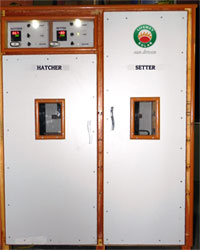
Fully Automatic 200 Eggs Solar System
This flagship fully automatic solar poultry incubator runs without depending on grid power or a generator. It is a 24V / 175W DC system built around proven solar, storage and control components for reliable hatching in rural and off-grid use cases.
Precision Hatching, Day and Night
Temperature Control
Precise and consistent control of temperature is essential for good hatching results. The fibre glass double-skinned box with puff insulation improves temperature stability and operational efficiency, while the electronic proportional thermostat is protected against power variation and backed by battery-supported solar charging for 24-hour supply.
Egg Turning
In the semi-automatic unit, egg turning can be done manually by turning each egg 4 or 5 times a day. With no internal electrical moving mechanism around the tray, there is nothing to trap or injure emerging chicks, while the fully automatic product line scales that same practical, low-risk incubation philosophy.

Humidity & Ventilation
A computer-grade fan provides fresh airflow throughout the incubator. Humidity is handled manually through a water bowl placed outside the incubator and connected to a perforated PVC piping system, balancing ventilation and moisture during the hatch cycle.

From Jhabua to Zimbabwe, Women-Led Livelihoods
Solar poultry incubators were distributed among villagers in Jhabua District, Madhya Pradesh on 13th July, with the next batch on 22nd July 2014 under the Rural Innovation Fund from NABARD, Bhopal division. Lifeway also works with Krishi Vigyan Kendras in 12 Indian states, including projects in Jhabua, Dhar and Burhanpur in Madhya Pradesh; Ranchi, Hazaribagh and Godda in Jharkhand; N.G. Ranga Agricultural University in Ananthapur, Andhra Pradesh; Jayasankar Agricultural University in Hyderabad; and the Meghalaya State Council for Technology and Environment.
Backyard poultry farming programs supported by Hazaribagh KVK, Deoghar, Godda and Ranchi under NABARD-backed KVK schemes included training and installation from 13th to 21st March 2016. Lifeway frames this work as women’s rural empowerment: “When there is no RAIN.... there is SUN.” Self-help groups in some villages, often ten women per group, can avail up to 30 lakhs in bank loans without collateral to start the project.
The incubators are also exported to Zimbabwe as part of the United Nation's African Poverty Eradication Program, with Lifeway joining hands with a UN agency in Harare to create awareness and employment for unemployed women in Africa. The export footprint further includes Nigeria, Afghanistan and Nepal, particularly shipments to Mr. Richard, RICALIS Enterprises Pvt Ltd, DBA Richards Agricultural Group, PO Box CY510, Causeway, Harare, Zimbabwe.
Lifeway also supports Kadakkanath medicinal chicken, originated from Jhabua, Madhya Pradesh, where 1 KG flesh costs Rs.1000.00 and each egg costs Rs.50.00. It is presented as profitable farming and a service to society, especially for heart and asthma patients.
- An excellent product for Kudumbashree – Self Help Groups to start self employment venture with bank loan.
- 30% capital subsidy from Ministry of New And Renewable Energy through NABARD.
- 5% interest loan from Syndicate, Canara Bank.
- Possible Kerala Govt. subsidies.
- Lifeway Solar Devices Pvt. Ltd., Cochin, Kerala provides manufacturing, project development and technical support to buyers and NGO partners.


Distribution of Incubators Among Villagers in Jhabua, MP, India
Original field documentation from the July 2014 distribution program, covering images dst_img1.jpg through dst_img13.jpg from the Jhabua rollout under NABARD support.


Related Pictures, Videos, Certificates
A curated portfolio from the original incubator page, including Limca recognition, field deployment in Jhabua, Kudumbashree engagement, training sessions and institutional awareness programs.


Frequently Asked Questions
Why should Poultry farmers go for solar incubators?
The advantages of solar incubator is when comparing with conventional one, it will work in three power options: Grid, Battery and Solar. The additional benefit is it will conserve energy, an eco friendly product and also easy to use.
Energy Conservation
The solar incubator can save up to 50% electricity, so that the hatching expenses will be less.
Environmental protection
According to the calculation, during the ten years using, each solar incubator will reduce the coal discharge into the atmosphere of 12 tons of carbon dioxide, 656 tons of carbon monoxide, 520 tons of dust, 162 tons of sulfur dioxide, 350 tons of hydrogen nitrogen compounds, this is not a small number, so the use of solar energy incubator is green environmental protection an effective measures.
Safety
At present Lifeway Solar design of solar incubator machine in 12 V as well as in 220V, you can make arbitrary choice before ordering our incubator. The operation is simple, comfortable, safe and reliable.
What kind of environment is suitable for solar incubator?
This is a Solar Energy Powered product designed for villagers. Millions of women living in our villages are without grid power. We are mainly focusing on this sector, creating employment opportunity for them — “A self employment venture by unemployed women.” 40% of the Indian population is without power supply. Most of the grid powered areas are also not having stabilized power for 24 hours. Power cut for 5 to 12 hours are even in cities, so they have to depend either on Diesel Generators or on Inverters.
Is it too complicated to install the solar incubator in villages?
The installation of solar incubator is very simple, we have set all applications on components before dispatch. Consumers need to connect it to grid and solar panels. Most of the time our installation team will assist you in installations in your area or it can be communicated through mobile phones.
Is it possible for us to use this Solar Energy to light up our house when we are not using Solar Incubator?
Yes, it is possible but only one 10 Watt CFL which is working on DC power can be used for 7 hours. You should install the Solar Module facing to south in 10 degree angle to harness sun rays from 10 AM to 4 PM. But do not light lamp CFL when Solar Incubator is working.
What is the lifetime of the solar Poultry incubator? Is it breakdown frequently?
No. It will not. This design is for minimum above 10 years life. However it all depends how you are going to use it. It is depend on circuit component aging or short circuit damaging due to misuse. When anything goes wrong call our Engineers or replace the damaged parts by local technicians.
What is the difference between normal incubator and the solar incubator?
The normal incubator which is available from local market is maximum power consuming product. You need to have an inverter or Generator if power fails. Otherwise the entire eggs kept for hatching will gets damaged. Where as in Solar poultry Incubator there will not be any power shortage or breakdown. Also there will be no recurring expenditure to run the Incubator.
Is it Possible for us to use this solar panels for some other purpose?
Yes. The energy harnessed by solar panels can be used for lighting your house also to use television and computer.
The chicks in my machine are fully formed, some pipped, but did not hatch. (late death) What went wrong?
This common problem can be caused by many factors. The most frequent cause is incorrect humidity – usually too high.
The chicks in my machine are only part formed (very early death) What went wrong?
Again number of possible causes: turning failure, bacterial infection in incubator, temperature fluctuations, power failure or problems with parent stock (e.g. in-breeding, poor nutrition).
The power has gone off. How long will the eggs be OK for?
Generally for a period of up to an hour. If the unit is well insulated and the temperature does not drop too much this could be longer. Our machine can keep about 3 to 4hrs.
How often should eggs be turned?
It is recommended that poultry, game and waterfowl eggs are turned a minimum of twice a day – ideally more often. Automatic turning is often hourly. Some species (parrots and birds of prey) need turning at least every hour.
How long can I leave the chick in the incubator after they have hatched?
Leave the chicks in the incubator until their down is dry – usually about 24 hours. They will not require food or drink in that time.
Should I spray the eggs during incubation or when they are due to hatch?
Spraying only increases humidity for a very short time and will not “soften” the egg shell. Spraying eggs can also transmit or spread infection and is therefore not recommended. The main effect it has on the egg is to cool it as the water evaporates. There is some evidence that periodic cooling can improve hatch results but this should be achieved in other ways (e.g. leave the lid open for half an hour per day).
When I set the eggs which way up should they be?
It is essential that eggs are set so that the round end upwards or they are on their sides.
I am confused about the correct temperature for my eggs. I have been told different temperatures by different people. How can I be sure which is correct?
Always refer to the manufacturer’s instructions as different types of incubators may require different settings.
When should I stop the turning?
Turning should be stopped and the machine set level 2-3 days before the eggs are due to hatch.
What is the correct humidity level for incubation.
Generally for poultry it is between 60-70% and last 3 days 70-80%.


Explore More Products
All Lifeway Products
Browse the wider Lifeway Solar range, from solar mobility and lighting to agricultural and power generation systems.

Home Lighting System
Reliable solar home lighting with efficient DC loads and backup for rural households.
